Birmingham's Victorian pubs, tiles and all
Minton tiles, snob screens, terracotta and copper ceilings. Birmingham built some of the finest pubs in the country around 1900, and a good number still pour a pint. Where to find them, from Curzon Street to Stirchley.
By Only Birmingham Editorial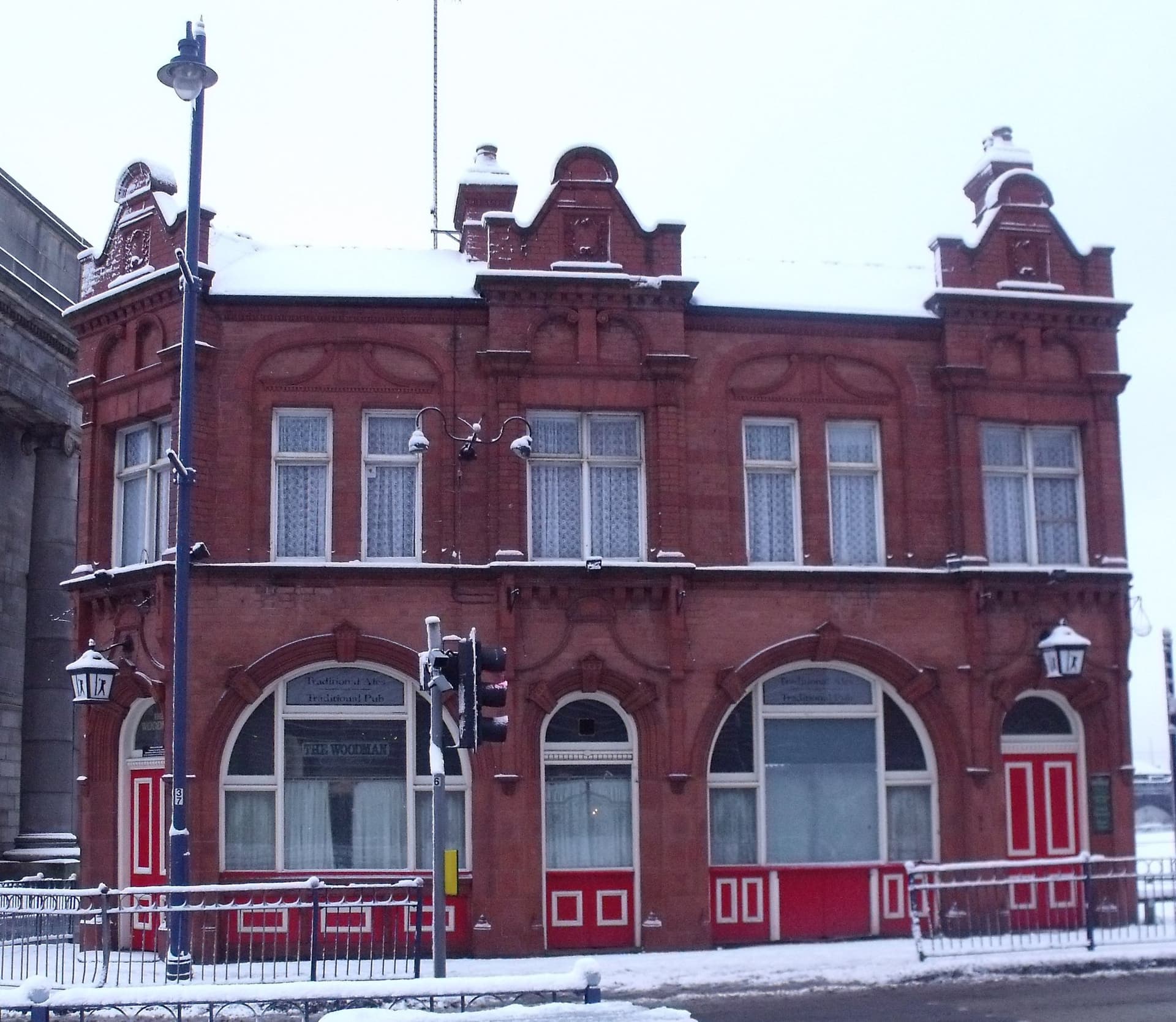
Start in Digbeth. Within a short walk of Moor Street you have The Woodman on Curzon Street, The Anchor and the White Swan on Bradford Street, three pubs built around 1900 whose tiles, screens and bar backs survived a century of brewers trying to modernise them. Birmingham's brewers, Mitchells & Butlers and Ansells above all, built some of the grandest pubs in the country between the 1890s and the 1920s, mostly through the architects James & Lister Lea. Plenty went. A good number did not. Here is where to drink among them, and what to order.
The Woodman, 1 Curzon Street
The pub that made Birmingham's case. Built in the late 1890s, it sits opposite the old Curzon Street station, and after a careful refurbishment it reopened in 2024 with its red brick and terracotta interior intact: an L-shaped bar, a smoke room, a snug and a library with a real fire. CAMRA gives it three stars on its National Inventory of Historic Pub Interiors, the top rating. Draught Bass and Hobsons Champion Mild are the regulars, with seven changing beers alongside. It opens at noon every day, closing at 9pm on Sundays, and there is a quiz on Monday nights. Dogs and children are welcome.
The Anchor, 308 Bradford Street
The Anchor was built in 1902 for Ansells by James & Lister Lea, and it shows: a timber and glass screen, an L-shaped servery and Art Nouveau glass in the upper windows. It is another three-star interior, a multi-room local next to Digbeth Coach Station pouring up to four cask ales and one key keg, with Draught Bass the one you will see most often. It fills up when Blues are at home. Dogs get free treats.
The White Swan, 276 Bradford Street
Five minutes further along Bradford Street, the White Swan is the tiled one. Built in 1899 and 1900, again for Ansells by James & Lister Lea, it has a tiled corridor, the original counter and bar back and a copper tile ceiling, plus a smoke room with a serving hatch and a Victorian fireplace. It came back in 2023 after two years shut. The catch is the hours: it currently opens Thursday to Sunday only, from 11.30am. Order a Pale Brummie and look up.
Craven Arms, 47 Upper Gough Street
Behind the Mailbox, on a side street most people walk straight past, the Craven Arms wears a full coat of blue glazed tiles on the outside. Inside it is one cosy room run by Black Country Ales, who restored it in 2022, with handpumps across the bar: Bradley's Finest Golden, Fireside and Pig on the Wall, plus changing beers from Birmingham and West Midlands brewers. Food is cobs, pork pies and sausage rolls. It is open from noon daily.
Rose Villa Tavern, 172 Warstone Lane
On the clock end of the Quarter, the Rose Villa Tavern is a little later, built in 1919 and 1920 for Mitchells & Butlers, but it belongs on any tile crawl. The walls are Carters of Poole tilework in cream, green and buff, with tiled paintings, a rear snug with a tiled inglenook fireplace and stained glass throughout. It is a late-night pub these days, open to 1am at the weekend, with sport on the screens and a Tuesday quiz. Real ale is not always on, so come for the room.
The Old Joint Stock, 4 Temple Row West
Not a pub by birth. The Old Joint Stock is a Grade II listed Victorian bank of 1862 opposite St Philip's Cathedral, now a Fuller's house: an Italianate hall under a domed skylight, with a tall carved island bar topped by a four-sided clock. London Pride, ESB and Gales HSB are on cask, and the studio theatre upstairs is one of the best fringe stages in the Midlands. Note it shuts at 6pm on Sundays.
Further out: Stirchley, Balsall Heath and Northfield
- British Oak, 1364 Pershore Road, Stirchley. Built in 1923 and 1924 for Mitchells & Butlers, with five largely intact rooms, a terrazzo floor in the public bar and a bowling green still in use. Three stars. Timothy Taylor Landlord on cask, burgers from Original Patty Men, and Bournville station a few minutes away.
- Hare & Hounds, 106 High Street, Kings Heath. Rebuilt in 1907 for Holt Brewery, with Maw & Co tiles in the York Road entrance hall and up the stairs. Three stars from CAMRA, and the upstairs room where UB40 played their first gig in 1979 is still a music venue.
- Old Moseley Arms, 53 Tindal Street, Balsall Heath. A 1920s rebuild with its period fittings, Bathams Best Bitter on the bar and a tandoori menu in the evenings. Walk from Edgbaston after the cricket.
- Black Horse, Bristol Road South, Northfield. A Brewers' Tudor giant from 1929 with a baronial hall and a tie-beam roof, run by Wetherspoon, so the beer is cheap and the room is not.
The one that got away, for now
The Barton's Arms on High Street, Newtown, is the most famous of them all: Grade II*, Minton Hollins tiles, snob screens and a stained-glass staircase. It is also shut. CAMRA lists it as closed long term since July 2025, with its future uncertain. Walk past and look at the outside, and keep an eye on it.
A Digbeth tile crawl
- Start: The Woodman on Curzon Street, for a Bass in the library.
- Then: down to The Anchor on Bradford Street for the glass screen.
- Then: on to the White Swan, Thursday to Sunday, for the tiled corridor.
- Finish: back into town and round to the Craven Arms on Upper Gough Street.
Go in daylight if you can; the tiles look best with the sun on them, and the rooms are quieter before the evening.